Technical Insight for Armoured Wheel Manufacturing
Heavy-duty wheel rims designed for armoured vehicle applications are subjected to significantly greater loads and stresses than conventional automotive wheels. Increased vehicle mass, altered weight distribution, higher centre of gravity, and demanding operational environments all place exceptional strain on wheel assemblies.
While many wheel rims marketed as “HD” or “Armoured” may appear visually similar, or indeed be cheap replicas of an existing MSW product, the true difference in performance and safety lies beneath the surface — in the quality of the raw materials used and the standards of the manufacturing process.
For armoured vehicle applications, material quality is not simply a manufacturing consideration; it is a critical engineering requirement.
The structural integrity of an aluminium wheel is heavily influenced by the quality and consistency of the alloy used during production.
High-Grade Primary Aluminium
High-grade primary aluminium provides:
– Consistent metallurgical properties
– Improved fatigue resistance
– Higher structural strength under sustained loads
– Better corrosion resistance
– Greater long-term durability
These characteristics are particularly important for armoured vehicles, where wheels must tolerate substantially higher axle loads and prolonged operational stress.
By contrast, lower-grade or poorly controlled aluminium may contain impurities, inconsistent alloy composition, or internal defects that compromise wheel performance and longevity.

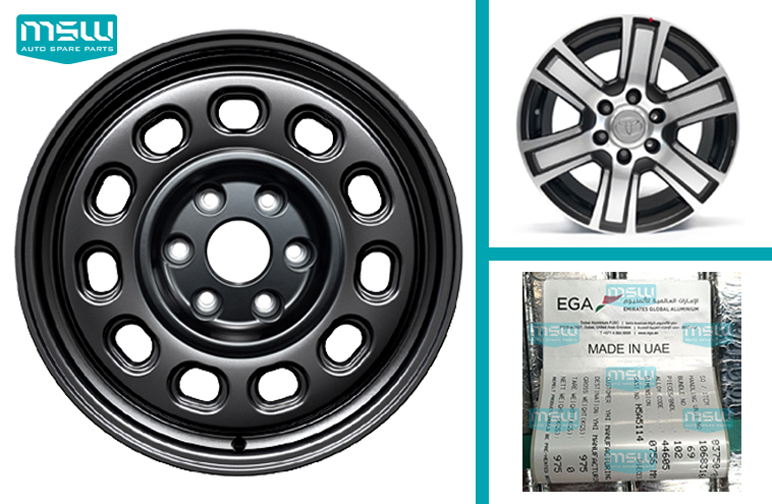
MSW’s HD Armoured Wheel Rims are manufactured using premium-grade aluminium sourced primarily from Emirates Global Aluminium (EGA), one of the world’s leading producers of high-purity primary aluminium.
Each batch of raw material is fully traceable, allowing verification of:
– Alloy composition
– Production batch
– Material origin
– Manufacturing consistency
This level of traceability helps ensure that every wheel begins with a controlled and verified material foundation before entering production.
Beware! Wheel manufacturers may reduce production costs by using recycled aluminium or lower-grade material sourced from secondary markets. While such materials may be suitable for standard automotive applications, they introduce serious risks when used in armoured vehicle wheel production.
Potential Issues
Potential issues associated with inferior raw materials include:
– Internal porosity within the casting
– Inconsistent alloy chemistry
– Reduced fatigue resistance
– Increased susceptibility to cracking
– Lower impact resistance
– Accelerated corrosion
These weaknesses may not be immediately visible but can progressively develop under operational loads. In demanding conditions, wheel rims manufactured from poor-quality material may experience:
– Fatigue cracking around high-stress areas
– Structural deformation under load
– Reduced off-road impact tolerance
– Premature material degradation
– Potential catastrophic wheel failure
For armoured vehicles operating in hostile or high-risk environments, these risks are unacceptable.
Material traceability is often overlooked when purchasing heavy-duty wheels, yet it is one of the clearest indicators of manufacturing quality.
Without documented traceability, it may be impossible to verify:
– The true grade of aluminium used
– Whether the material originated from a certified producer
– Consistency between production batches
– Compliance with engineering specifications
Many wheel rims can appear identical externally while differing significantly in material quality and structural integrity.
MSW recommends that buyers evaluating armoured wheel rims always request validation of:
– Wheel load rating certification
– Raw material source and alloy grade
– Material traceability documentation
– Manufacturing facility accreditation
– In-house testing certifications and procedures
These factors are critical in determining whether a wheel is genuinely engineered for armoured vehicle use rather than adapted from standard automotive applications.
Even high-quality raw material can be compromised by poor manufacturing practices. For armoured wheel applications, manufacturing facilities should operate to internationally recognised quality standards and employ rigorous inspection procedures throughout production.
MSW’s HD Armoured Wheel Rims are produced in state-of-the-art facilities accredited by TÜV to JWL and VIA specification. Every wheel undergoes comprehensive validation procedures including:
– X-ray inspection
– Leak testing
– Dynamic load, fatigue and impact testing validation
– Finite Element Method (FEM) Analysis
– Salt spray corrosion testing
These tests help confirm structural integrity, casting quality, and long-term durability under demanding operating conditions.
Armoured vehicles generate significantly greater loads than civilian platforms, placing continuous stress on wheels, tyres, braking systems, and suspension components.
Under these conditions, wheel material quality becomes a major contributor to:
– Vehicle safety
– Operational reliability
– Durability under load
– Long-term maintenance performance
– Resistance to environmental degradation
The use of verified high-grade aluminium combined with controlled manufacturing and testing procedures helps ensure that wheel rims perform consistently throughout their service life.
In armoured mobility applications, wheel rims should never be assessed on appearance alone. True armoured wheel performance is determined by:
– Material quality
– Metallurgical consistency
– Load validation
– Manufacturing standards
– Inspection procedures
– Real-world durability testing
For this reason, MSW maintains strict control over raw material sourcing, manufacturing accreditation, and quality assurance processes to ensure its HD Armoured Wheel Rims meet the demands of modern armoured vehicle operations.